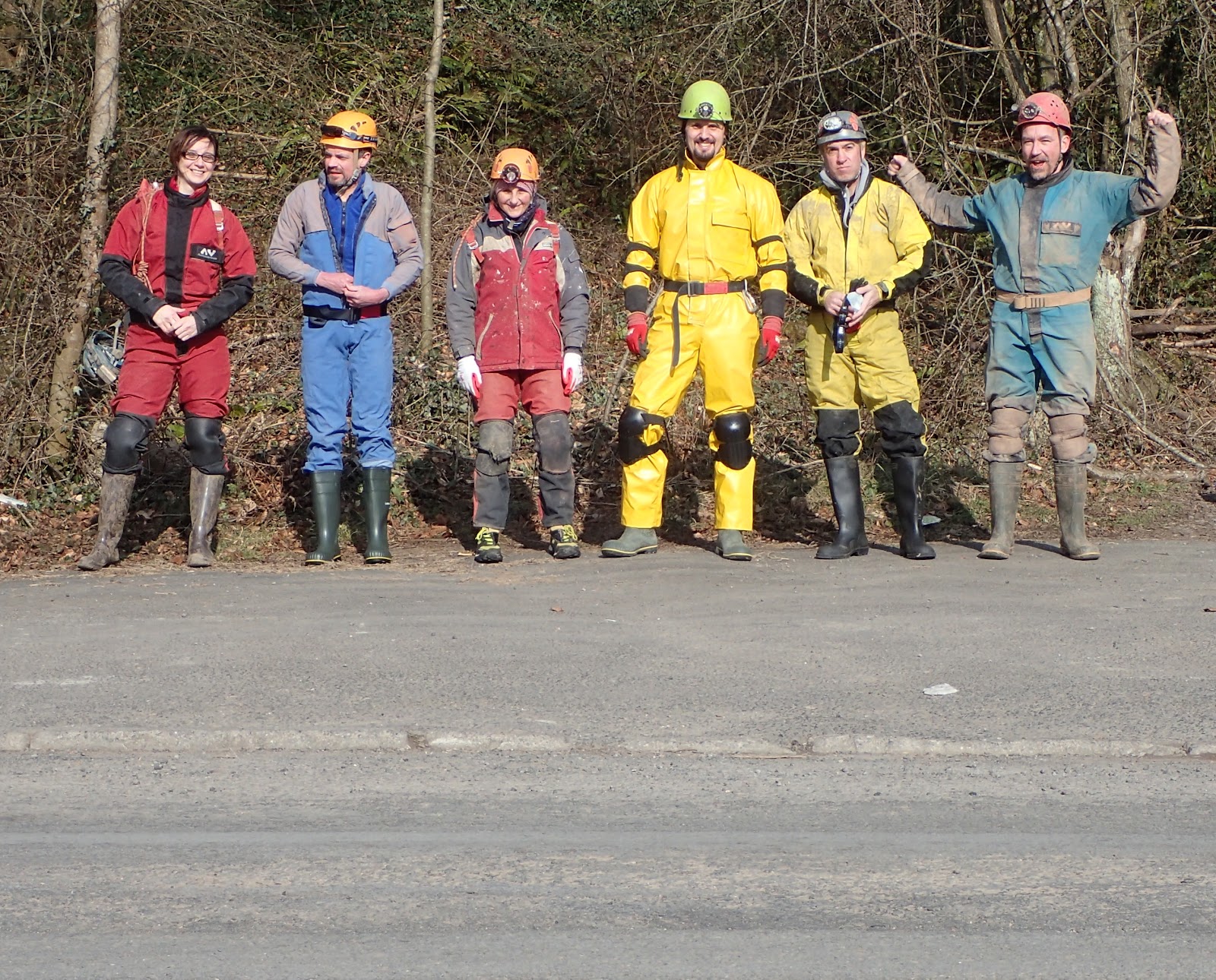
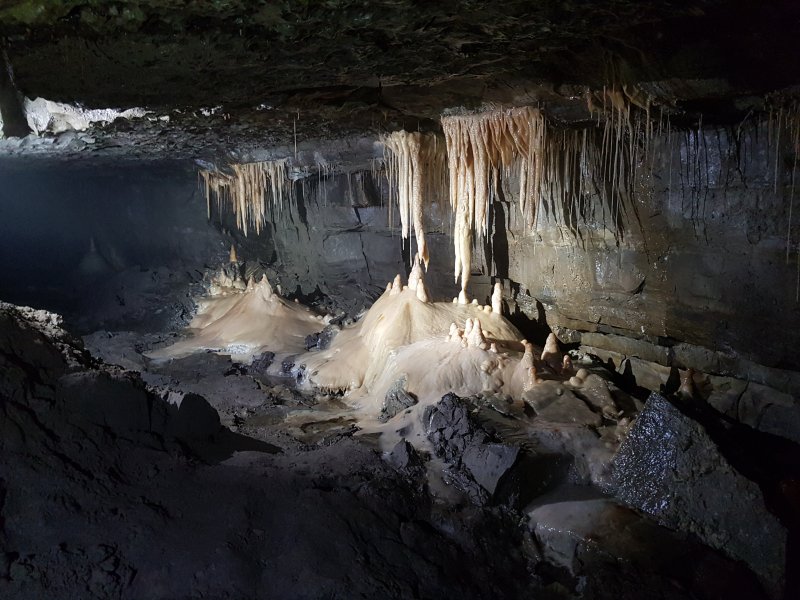
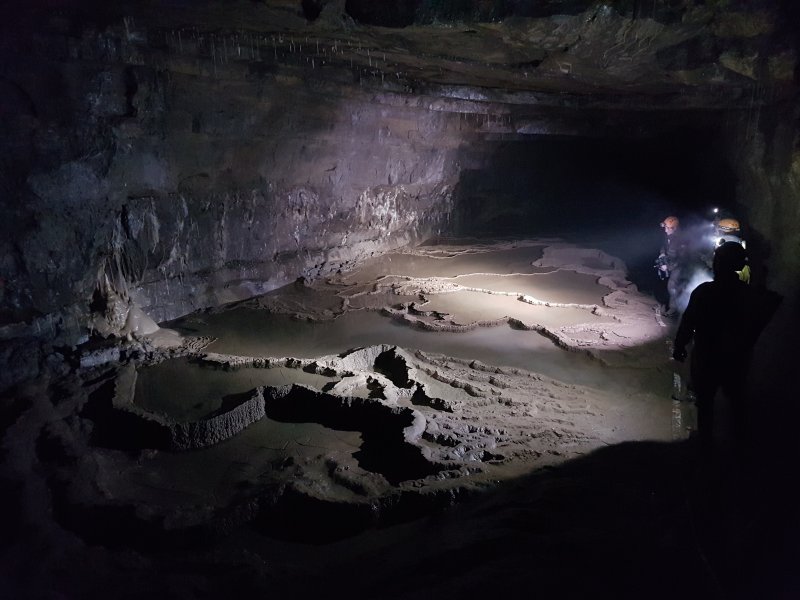
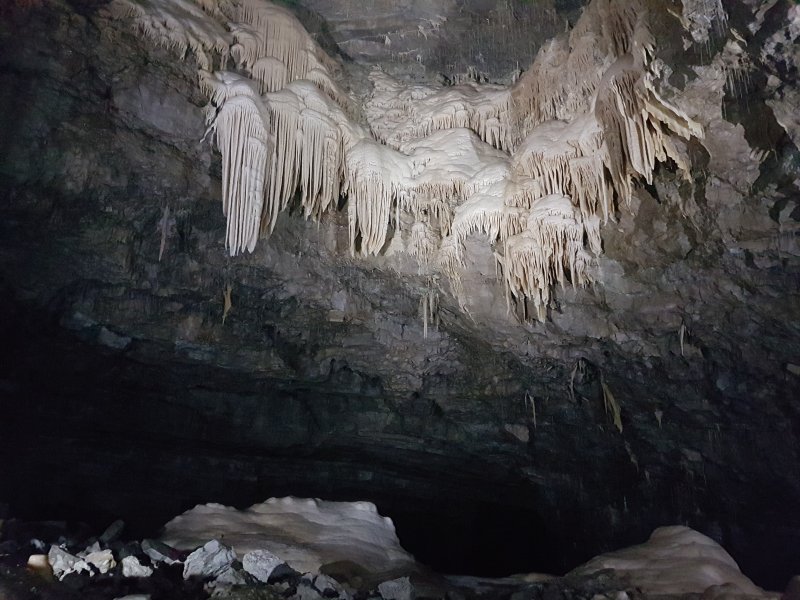
Team: Paul Crowsley, Si Lowis, Lesley Markie, John Roe, Samsung S7, Claire Vivian, Neil Weymouth, Tarquin Wilton-Jones.
Report and photos: Tarquin Wilton-Jones.
This was a very welcome chance to visit one of my favourite caves with some SWCC friends, and at the same time look for some newly recognised formations. The weekend had been booked long in advance by the ever-organised club meets secretary. Sadly the weather could not be booked in advance, and some snow had decided to coat the hills. Certainly beautiful, but the single track lane to the Llangattwg caves has no chance of being cleared by the council. Having grown up in these hills, snow is just a fact of life and quite fun to drive in, but several members of the teams were forced to pull out of the trip after reports of crashes blocking major roads on the Friday evening.
Still, 7 of us had braved the roads, 6 arriving on Friday, and me
joining on Saturday. One had tried and failed to ascend the
treacherously steep roads up from Crickhowell, but all of us eventually
used the Hafod road, that runs level all the way around the mountain
from Brynmawr along a former tramroad. At one point, it runs above 70
metres of slope and cliff dropping down to the Blackrock road below,
with only a few little wooden posts offering very little psychological
support. The view, however, is stupendous. By Saturday morning, the
compacted snow had earned an icy crust, and the final section towards
the Whitewalls caving hut added a little extra excitement with no grip
whatsoever for a short section, where drops on both sides offered an
alternative to the road as the car pretended not to understand the
commands being sent by the steering wheel.
The plan was to spend two days at Whitewalls, visiting Agen Allwedd -
Aggy - on Saturday, and other local caves on Sunday. The seven split
into teams of four and three, visiting the Aggy Inner and Outer Circles,
and The Courtesan plus Grand Circle respectively. Panoramas and Circles
pictures by Tarquin, unless otherwise stated, lighting of big passages
by everyone on the trip.
 |
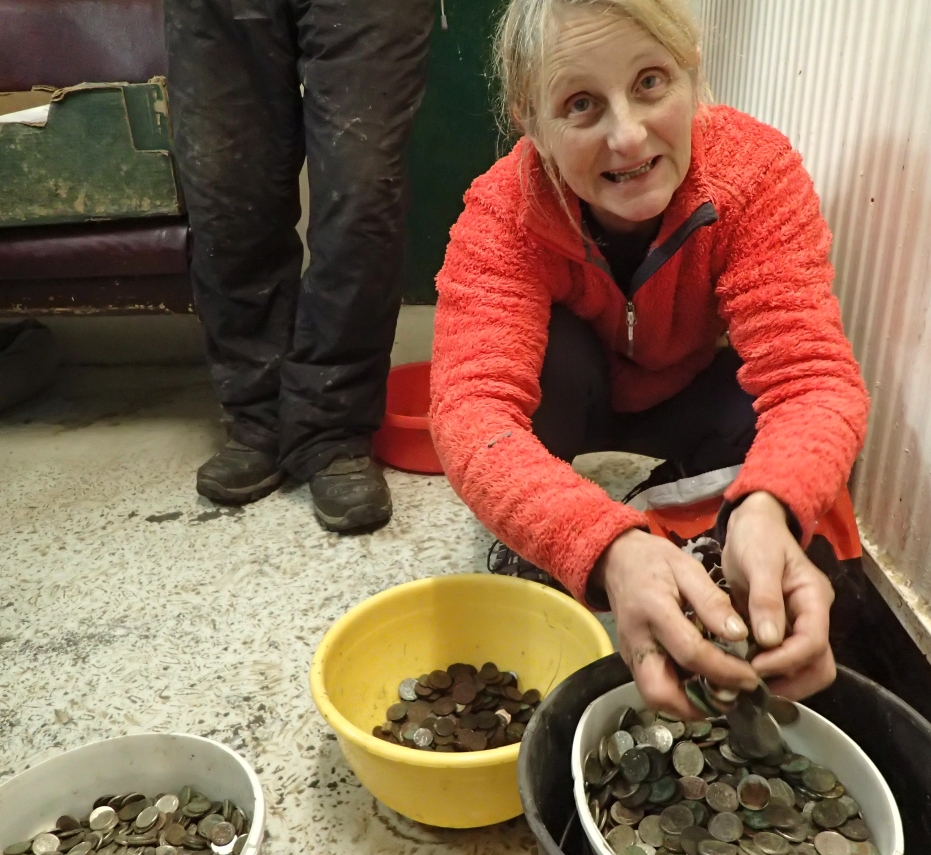
| Si, Paul, Leslie and Tarquin |
Aggy Inner and Outer Circles
Team: Tarquin Wilton-Jones, Claire Vivian, John Roe, Si Lowis
 |
| The Black Mountains from the Tramroad |
 |
| Cwm Onneu Fach and the Llangattock Escarpment |
This is one of the Aggy classics, taking in most of the largest
passages in the system, excellent streamways, a great many grand old
stal formations, a very committing tight squeeze, and one of the cave's
lengthy workout passages. The 2 km walk to the cave is one of the most
scenic in the national park, with a dramatic escarpment on one side, and
a view over the Black Mountains ridges on the other. In conditions like
this some decades before, a former clubmate of mine had accidentally
tested the steepness of the slope below the tramroad, and somehow
survived without any significant injury despite a very rapid trip to the
trees 50 metres below.
The familiar Entrance Series is one of the best places in the UK to
see lesser horseshoe bats, which adorned the walls at almost every turn.
This was particularly special for Si, who had never seen so many in one
place before. The junctions quickly passed, go right out, or get left
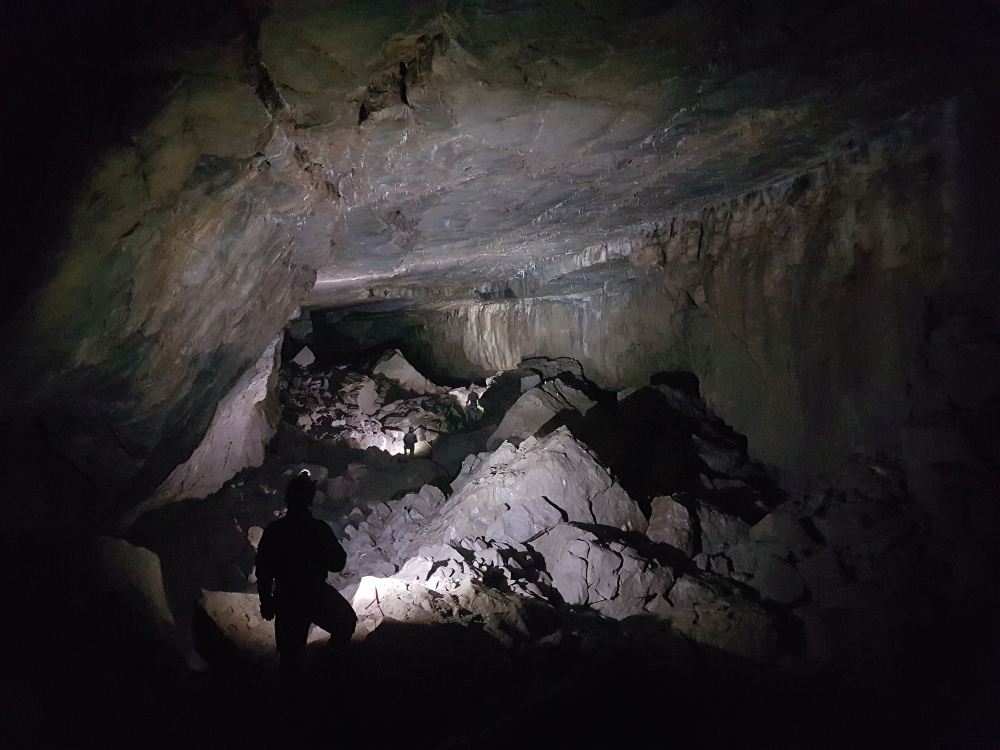
in. First Choke then reached Baron's Chamber, and the splendour of the
enormous Main Passage.
 |
| John, Si and Claire in Main Passage |
This is where the hunt for white powder began, but sadly the only
powder was the prevalent piles of spent carbide, a relic of the lack of
conservation of past eras. Thankfully, carbide and its soot marks and
waste piles are now banned from these caves, but the past damage still
remains, and it made it much harder to search for a white powder, among
the white powder.
Main Stream Passage's mix of splashing and boulder hopping provided
some entertainment, and after a couple of false starts with photography
of what is almost certainly just carbide (doh!), we reached the Second
Boulder Choke. If you manage to spot them, there are even a few
proto-shark fossil spines here, similar to those in Draenen. A short
choke then a distinctive climb down into a side passage, followed by
another climb down and return to the Main Stream passage, reached the
grovel in the stream below the longer part of the choke. A climb up
boulders then reached Keyhole Passage, my personal favourite (so why is
there no photo?!), a perfect phreatic tube with a deep vadose trench
meandering in the floor. We took the upper route, crossing the deep rift
repeatedly on the ledges, and then dropping down the climbs to the
stream at the far end.
The streamway then lost its boulders, and the increasingly slippery
floor brought us to Northwest Junction. From here, we headed upstream
along the longest uninterrupted streamway in Britain, Turkey Streamway,
named after a rather odd shaped stalactite. The occasional formations
began at The Beehive, which serve mainly as a reminder that Aggy does in
fact have formations. Somewhere. The streamway is excellent, and
overshadows the stal, though the stal is in fact quite attractive in its
own right. Just before Turkey Pool, a small pile of crystals looked
suspiciously like the white powder I had been looking for, but sadly is
probably something else entirely, due to the proximity to the stream.
The deep pool appears at first to be a sump, but a rift tucked to the
left is the way on. A fun obstacle, narrow and with few holds above the
chest deep water, but it is possible to get through with dry feet if you
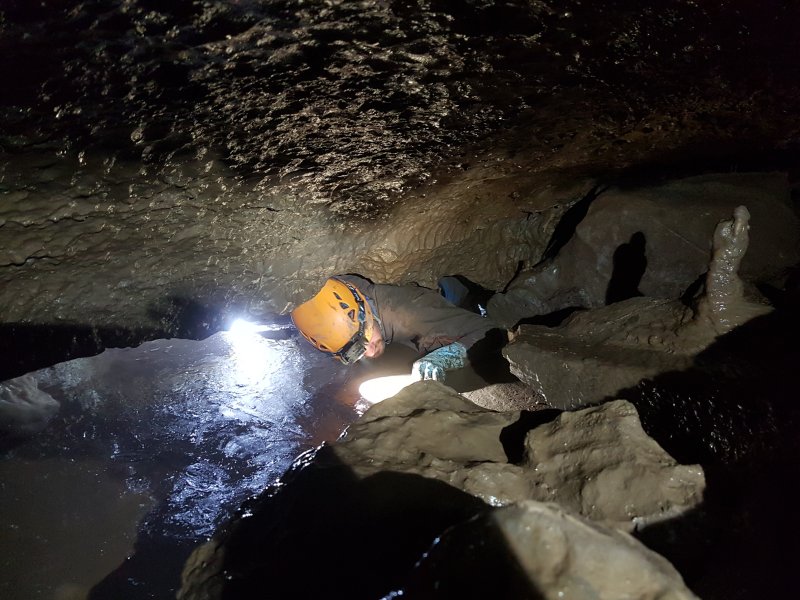
traverse well. Most of us managed, with only the odd wet foot (Claire managed to get one wet foot). The
brief enormity of Turkey Chamber gave a hint of the grandure yet to
come.
 |
| Claire crossing Turkey Pool on an earlier trip (using the same foothold and getting the same foot wet) Photos: Andy Freem |
A short section of streamway, and we took a small side passage
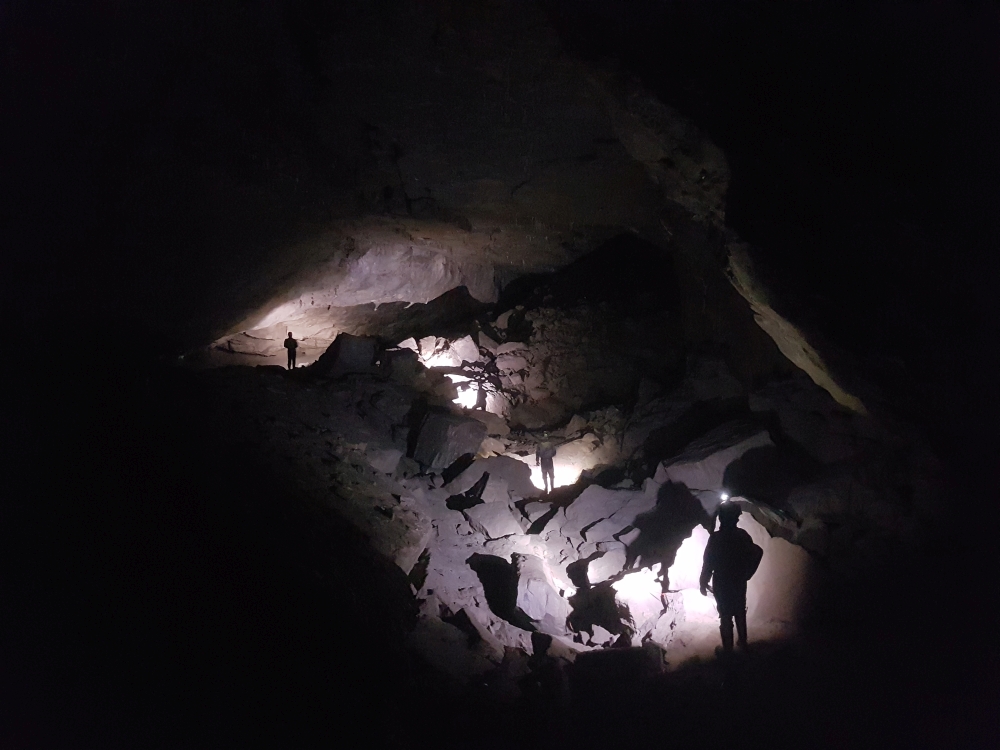
into the very impressive Sand Caverns, where we stopped for the first
passage photo. This passage is so much bigger than it feels like it
should be, a remnant of a much older drainage system. The end of Sand
Caverns was as far as Claire had been in Aggy, and it is always nice to
have someone enjoying a first visit to the rest of the area, since it is
very dramatic indeed.
 |
| Claire and John in Sand Caverns |
 |
| John, Claire and Si in Sand Caverns |
 |
| Cross section through fossilised Brain Coral |
From Sand Caverns, we took the crawling-sized Selenite Needle Passage
instead, with the walls soon becoming decorated with small amounts of
selenite, and occasional poor helictites. The main feature, however, is
the Nodular Bed that makes up the roof. Initially seeming just like
limestone rocks embedded in shale, a recent visit brought the revalation
that the rocks are almost certainly fossilised brain corals. Some of
them are preserved well enough to see the characteristic surface texture
of the corals, with the bright purple shale filling the gaps between
them. In many cases, the coral has been cut open by the cave, leaving a
visible cross section with large crystal rays extending outwards - the
growth pattern of the coral.
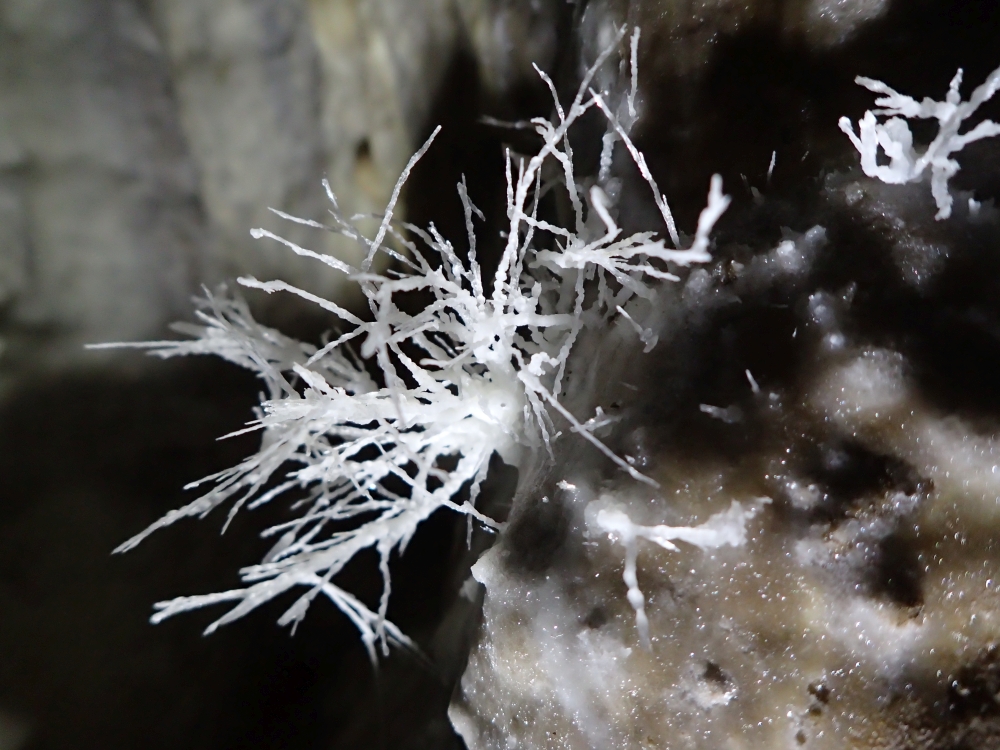
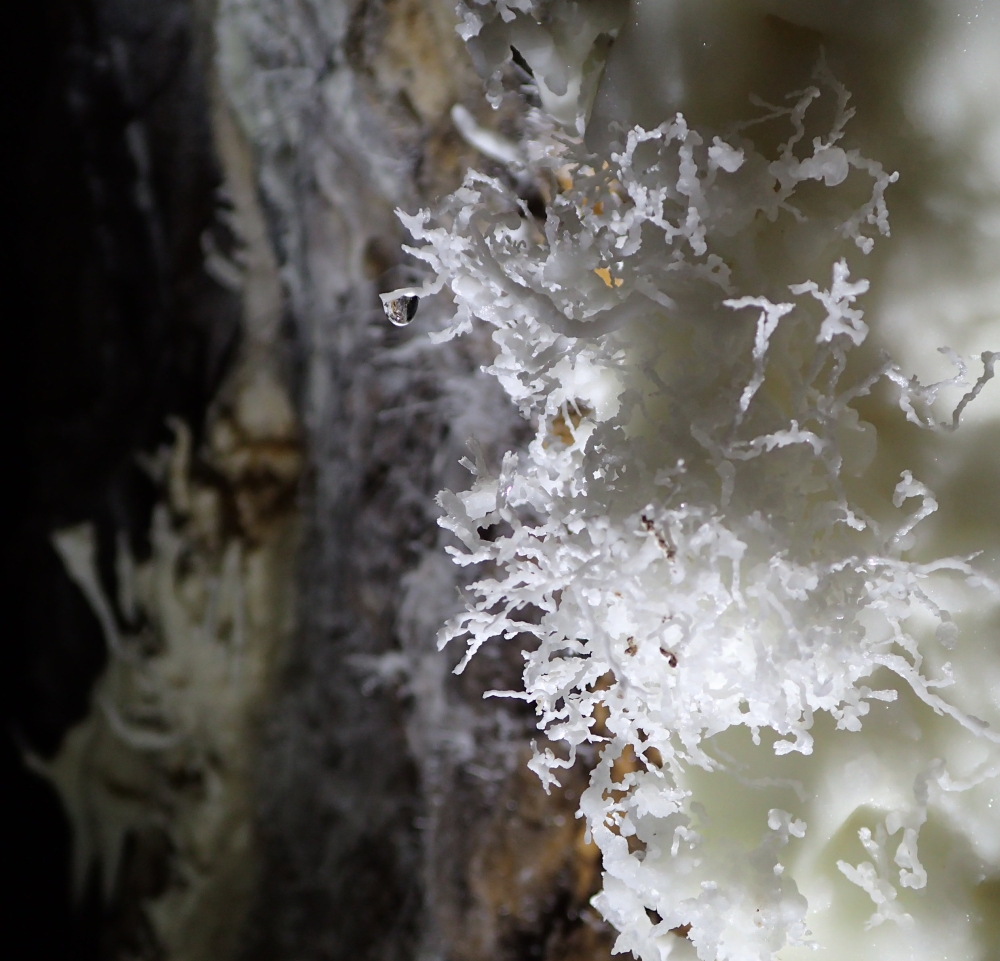
At the end of the passage, the walls are decorated with extremely
elaborate, pure white growths. Here, the stream is gained, and a second
inlet then signifies the start of the Inner Circle. The survey of this
area rather appropriately looks distinctively like a simple drawing of a
turkey; the body is the Inner Circle, Midsummer Passage and Swiss
Passage are the tail feathers, Selenite Needle Passage and an inlet are
the legs, Disappointment Chamber and a side passage are the bottom and
top of the head. We continued along Eastern Avenue, following the Inner
Circle anti-clockwise, since this gets the most dramatic reveals of the
passages. At Midsummer Passage, we turned left, to reach the junction
with Swiss Passage.
Swiss Passage is always worth a visit, to admire the beautiful mud
formations. First are the dried crystal pools hiding in the undercuts,
surrounded by the untouched mud. After that is the iconic Swiss Village,
a series of miniature hoodoos formed by water dripping onto the mud,
with each pinnacle protected from the water by a tiny pebble.
 |
| Swiss Village |
After Swiss Passage, we headed in the other direction along Scree
Passage. The first and most obvious obstacle is the First Scree Slope, a
steep slope of scree (in case the name didn't give it away), and the
team very kindly took their places at various stages up the very awkward
slope, for a picture. At the top is a distinctive chamber, with a
ceiling adorned with immature helictites, and a natural dry-stone-wall
of boulders that have peeled away from the roof.
 |
| Si, Claire and John on the First Scree Slope |
 |
| John and Claire above the First Scree Slope |
After a great deal of searching throughout the trip, my persistance
finally paid off. Scree Passage presented some white powder, that was
not just another scattering of spent carbide. This was clearly going to
be cryostal, exactly where I had hoped to find it. My shout of "Eureka!"
was no doubt rather comical considering how meagre the dusting was, and
how willing everyone else was to just walk past it. "All that
excitement for that?!" "I have to admit, I wouldn't even have noticed
that, I would have just stood on it." were comments heard. And this is why it has only
recently been recognised.
 |
| Cryostal in Scree Passage |
The Second Scree Slope once again presented another photographic
opportunity, and the rest of the team kindly obliged, dodging the rocks
dislodged by those further up the slope. The Dome of Saint Paul's at the
top is very hard to capture without a very wide angle lens. The chamber
is almost perfectly circular, with layers of shale and thin limestone
making up the walls, and an extremely flat ceiling. It is also quite far
above, so lighting it proved a little too challenging for the camera.
Oh yes, the camera. It's not a camera, it's a phone. All of the pictures
are taken with a phone. Because everyone wants to take a delicate
touchscreen worth several hundred pounds underground, to take pictures
of white powder, right?
 |
| Claire, John and Si on the Second Scree Slope. |
The descent into Saint Paul's Passage is one of the most dramatic in
the cave, and the passage is simply enormous, rivalling the giant
passages of Daren Cilau and Draenen. In the floor, I managed to find
another set of probable cryostal looking like gold nuggets, while the
rest of the team tried to decide if a side passage was the way on (the
turkey's head). The rest of the Inner Circle passed fairly quickly, with
a short low crawl regaining the brief large chamber and passage, before
rejoining Eastern Avenue to close the Inner Circle loop.
Once again we followed Eastern Avenue, this time turning right at
Midsummer Passage. This really looks big on the survey, and it certainly
starts so, but it quickly chokes. A crawling-sized route beside the
choke regains the larger passage. From here on, the survey is a little
optimistic, showing a large passage. It certainly is wide in places, but
it is very low, requiring two flat-out crawls and a lot of stooping.
Just as the passage regained its former grand size, we instead located a
silly hole dropping down behind a large boulder. This is the top of the
infamous squeeze. 7 years ago, this was the squeeze where I finally
lost my caving nerve, with flashbacks of a recent epic in Draenen.
However, in 2017 I had passed it and proved that although it may feel
intimidating, it is a lot easier than it appears at first. On that
occasion, the great Clive Westlake had patiently tested the squeeze and
led the rest of us through once he found the tactic that worked.
The hole descends diagonally to a very narrow rift, where rather than
descending the obvious but impossibly tight slot below, you have to
squeeze horizontally over a rock, keeping your body high in the widest
section. At the next slot down, turn so that your feet point downwards,
then descend to emerge from a seemingly impossible position in the roof
of a passage. From above it looks insane. From below it looks like a
piece of paper would struggle to fit through it. In the past, I would
send a smaller caver through first then drop head first since it is
easier - but horrifyingly committing - that way. This time, I was the
first through, and it all simply worked, feet first.
 |
| Si committing to the horizontal section of the squeeze |
Si spent some time trying to work out how to get his chest through
the tightest section, and no amount of guidance can make your chest
smaller - let's face it, there was no guidance anyway, since I was
preoccupied with videoing it. After nearly having to abandon the
attempt, Si finally found the solution, forced himself through with a
bruise for his trouble, and emerged from the slot with a well earned
sigh of relief. Claire soon followed, backed up with Si's guidance. John
seemed to take it in his stride, and soon joined us, saying that he was
more familiar with tackling the squeeze upwards, since at least you can
more easily back out if you fail to get through, but that also means
far more cavers fail to get through, since gravity is working against
them. Having backed out once while descending into the squeeze, I can
say that it certainly is possible to re-ascend if you decide not to go
through after all. On the way down, one tactic is to put all of your
valuables, especially your car keys, into a bag and drop them down the
hole first - then you are forced to complete it in order to retrieve
them. No backing out.
 |
| Claire squeezing in to Coal Cellar Passage with Si's guidance |
The hard work had begun. Coal Cellar Passage is about 0.5 km long,
and very sporting. For a long way, there are few places where you can
stand, with awkward crawls and thrutches over rocks. At one point, the
passage appears to close down completely, and an earlier crawl in an
undercut is needed to regain the way on. Further on, sideways walking
becomes possible as the passage becomes a very narrow rift. It is rare
to be able to turn around, so one leg ends up doing most of the work. In
many places, it was impossible to turn your head to check on the cavers
behind you, so we had to rely on the "you still with me?" checks.
Sideways squeezing is sometimes the only way to make progress.
Occasional jammed rocks and one memorable calcite obstruction force
climbs up the slippery rift without holds of any kind, with Claire's
petite stature needing a carefully placed sacrificial caver as a
foothold. An inlet finally increased the passage dimensions so that
regular walking became possible, at least for some of it.
Now well muddied, we reached Turkey Junction, and the Outer Circle
was complete. The return journey was quite methodical, back through the
familiar passages. The climb up into Keyhole Passage and the climb up
between the sections of Second Boulder Choke being perhaps the only
places which presented a significant challenge. We stopped to photograph
Main Passage, then Si tested his memory by leading out through the
entrance series. Go right out, or get left in. Over to the right.
Further right. The entrance to First Boulder Choke is definitely
confusing.
The Entrance Series was over pretty quickly, and we soon passed the
large collection of peppered moths, herald moths and cave spiders to
emerge onto the snow-covered tramway. "White powder? Whatever you do,
don't look down." A speedy trip, 6 hrs 45 minutes. A frosty walk back,
where Claire decided not to race through Eglwys Faen - next time, maybe -
and the white-roofed Whitewalls appeared as a welcome sight. Hot
showers, a gratefully received cup of tea, chocolate biscuits, and even
the offer of pizza! Sadly, our hopes of a curry in Crickhowell had been
dashed by the ice on the steep Crickhowell road.
While waiting for the other team to complete their unexpectedly long
Courtesan trip, we checked the mountain weather forecast, and it had
become much worse. Icy temperatures, blizard conditions, gale force
winds, sleet causing rapid snowmelt and flash flooding, then more snow.
None of us wanted to risk caving or driving the next day, so we decided
to back out early and head home. The road back was safer with the ice
melting, but would be absolutely treacherous the next morning. By
Sunday, most of the Valleys were thickly covered in snow, and more was
arriving. A good decision.
As always, I would like to thank my team mates for the excellent
company and patient photographic modelling during the trip, and
especially to Claire for making all the arrangements. Even if you
couldn't arrange the weather.
Aggy Courtesan and Grand Circle
Team: Paul Crowley, Leslie Markie and Neil Weymouth.
This was originally proposed as a Courtesan trip, but by the time the
logbook got filled in, it had become a Grand Circle trip too,
presumably to avoid having to do Southern Stream Passage twice.
Up to Main Passage, the trip is the same as the Circles trip. From
there, it stays with the Main Passage for longer, mostly walking along a
large, mud-floored phreatic tube. At the giant portals of Southern
Stream Passage, the large passage with selenite-covered walls is
short-lived, and a hole down in the floor is the start of the real
Southern Stream. At first, it is possible to walk for about 500 metres,
but after first and second inlets, it lowers to stooping height, with
several crawls forced by boulders. This gruelling section lasts for 600
metres, ending at a climb down at Waterfall Chamber. The walking sized
passage returns, until a larger tube in the roof signifies Gothic
Passage.
Climbing into Gothic, a crawl leads to the choice between the Priory
Road and Maytime routes. Priory Road starts small but soon enters a much
wider passage. The Iles Inlet side passage then reaches The Courtesan,
one of South Wales' finest helictite formations, described as "much
larger than you expect it to be".
 |
| The Courtesan (photographed on a previous trip). Photo: Duncan Hornby |
Returning to Southern Stream Passage, the tall rift passage continues
a great deal further, eventually forcing a traverse on slippery ledges,
to reach the wide river of Lower Main Stream Passage. The pools here
force a 50% soaking, as you try to make your way upstream. The biggest
challenge, however, is the floor, which can be incredibly slippery,
depending on the season, sometimes as bad as ice. The passage is
enormous, but you spend so much effort concentrating on staying on your
feet that it is hard to appreciate the space above you. Two tricky
cascades which often result in a complete soaking then precede the
abrupt Fifth Choke.
A climb up a knotted rope leads high into the roof, into Biza
Passage, and a complete change in character. A phreatic tube with heavy
scalloping, and an occasional vadose trench, normally walking or
crawling sized, with a couple of climbs. Finally, a lengthy descent
through the substantial Fourth Choke regains the dark and muddy Main
Stream Passage. This soon leads to Third Choke, where the way on is not
at all obvious, starting by dropping down on the right into the stream,
and randomly heading through the choke without any solid walls, roof or
floor. It emerges in another muddy part of the stream, the end of the
longest uninterrupted streamway (combined with Turkey Streamway).
The Narrows usually require a chest-deep dunking at each end. It is
possible to traverse most of the narrow section either fully out of the
water, or at various levels partly in the water. It is deep enough to be
completely submerged if you lose your grip. Pools called Deep Water can
be passed with care with only a waist-deep wade. The slippery floor
soon returns, for a very long way until Cascade Inlet, where the floor
suddenly becomes quite grippy at last. A short distance on, and it
reaches Northwest Junction, where the way out matches the Circles route.
10 hrs 45 mins, arriving back substantially before the callout time. All's good.