Thursday, 2 May 2024

Cueva el Soplao

Its always a good recommendation when a bunch of cavers recommend a show cave, but everyone who had been had said how impressive Cueva el Soplao is, so we decided to go on a rest day during our Cantabria trip. As it's Spain, which completely shuts down over lunch time, we had plenty of time for a walk around the area to see the beautiful scenery. We had a glorious day, despite a rainy forecast.


Cueva el Soplao was discovered by miners in around 1908, who were mining for blende and galena. Its amazing to think the cave was preserved, it must have been stunning for them. There is also a section of mine the public can go in occasionally. We had a lovely walk along the easy tracks, then a rummage around off the beaten track to see if we could find any evidence of mining. There was a few old mine buildings, very different in style to what I'm used to seeing in the UK.


Mining building

There wasn't much left of the inside of the building, but because there were isolators and wire mountings, we wondered if it used to be a communications hut or a signing in room.

Inside the building

Tall building, tiny doorway


We found a very well blocked off entrance to a mine, and an accessible one, but alas, we had forgotten our wellies and it got very claggy very quickly, but we explored what we could without getting filthy. The perils of having a hire car.


We went from old remnants of mining history, to some modern sculpture. Some excellent and a compliment to the miners, some a bit, well, different. 


After a very pleasant few hours, it was time to go catch our train into the cave. Normally this would seem a bit cheesy, but it was well done. You could imagine a miners plateway running into the hillside, carrying trugs of galena, then emerging into a stunning chamber. The cave is wheelchair accessible and has very easy walking pathways, but it was surprisingly in it's lack of fencing and how well done the lighting was. The formations were still so pristine.

We had to keep up with the guide, and lights were turned off behind us, so taking photos in the cave had to be done quickly. I've included a few here to show how beautiful the place is, pretty much taken on the run. If you ever go to Cantabria region, Cueva el Saplao is well worth a visit. Cueva el Soplao


Sunday, 31 March 2024

Stabilising the Cwm Dwr choke

Friday the 29th March saw a team of 10 people come together and help stabilise the recent movement in the Cwm Dwr choke.

The choke is an important link for through trips and deeper access into Cwm Dwr.


Dave Dunbar went ahead and installed Cave Link in a suitable area near the choke.  Upon returning to the club and after confirming a connection to a Cave Link setup in the small common room, the advance team dragged in clamps, bars and kit. The advance team included: Tony Baker, Claire Vivian, John Roe, Jules Carter & Laura Carter-Greaves.


Paul Quill and Vince Allkins remained on the surface to help prepare lengths of scaffolding. Custom lengths were messaged through to the club using Cave Link. This worked really well and avoided the need for people to courier requests to the surface.


The second team comprised of Duncan Hornby, Adrian Turner and Alfie Exall (York University) dragging in the bespoke lengths. They were met by Claire in the crawl who helped with the scaffold bars.


Scaffolding was installed and Adrian was brave enough to pass through and model for the camera!

Advance party at club preparing to enter Cwm Dwr.
Cave link set up in small common room.
Alfie dragging in the custom cut lengths through the beginning of the crawl.
Laura passing poles into the choke.
Passing poles into the choke.
Duncan passing pole into the choke.
Cave link in Cwm Dwr used to update surface team and request bespoke lengths in a very efficient manner.
Tony sorting kit within choke.
Choke stabilised.
Adrian for scale.

Wednesday, 29 November 2023

Beyond Big Chamber


After spending Sunday morning cleaning mould and plaster dust from bunks, in preparation for SWCC going back to normal operations, we didn’t have much time for a big trip, so we decided to go investigate a hole in the floor beyond Big Chamber.

De-moulding the bunkrooms

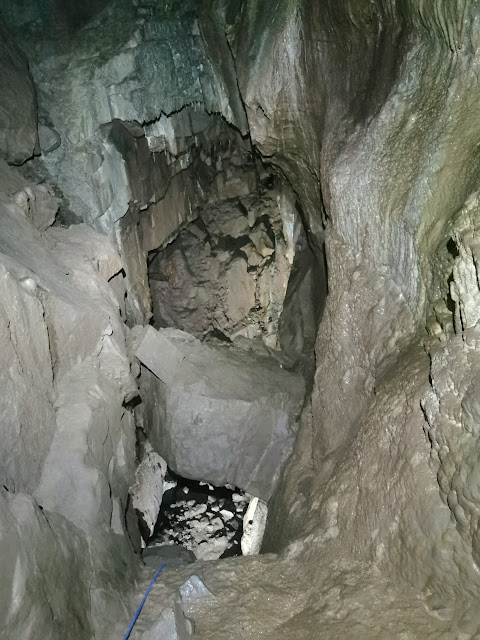
We’d found this hole on a previous trip, when we were looking for a tight miserable crawl through hanging death. Instead of finding hanging death, we found a hole in the passage, with a traverse off to the left, which neither of us could remember. From the top of said hole, it looked like a fair drop. It was probably a very easy drop down, but self-preservation won over bravery, and we’d agreed to return another day with a rope.

The tempting hole

So on Sunday afternoon, we headed off to check it out. The survey wasn’t giving many clues, the pitch / climb appears not to be marked, and the survey didn’t quite agree with our recollection of the layout. My wellies had disappeared, so I was caving on ice skates borrowed from the tackle store. Caving on ice skates is not to be recommended!


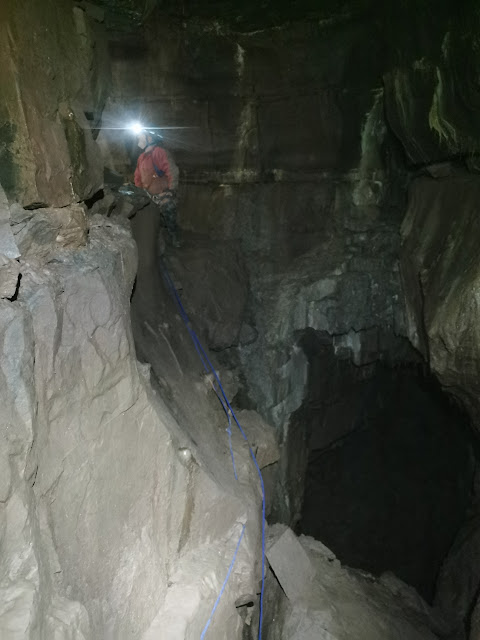
Paul rigged up a safety line so he could go check out the traverse. From the passage, it looked very tempting, but as we’d guessed from the location, it rapidly crapped out.

The View to Nowhere

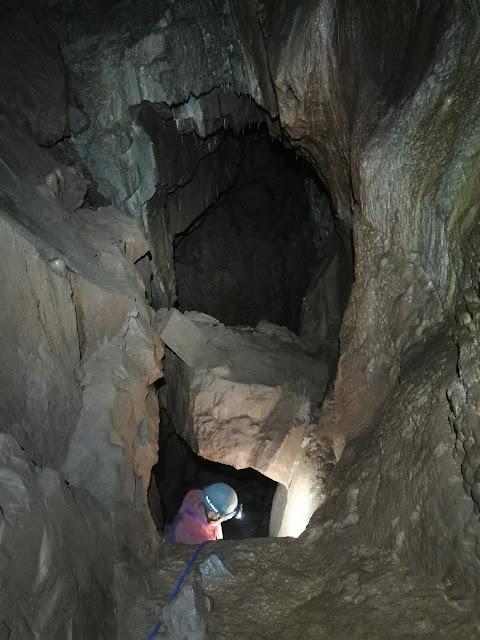
We then dropped down the pitch. You drop a metre or two onto a boulder a couple of feet square, then descend through a hole, and after a short free hang, you’re done. For me, definitely a pitch not a free climb.

Paul descending the hole in the floor

We’d dropped into a boulder chamber, with several hopefully looking routes out, however, most lead to disappointment.
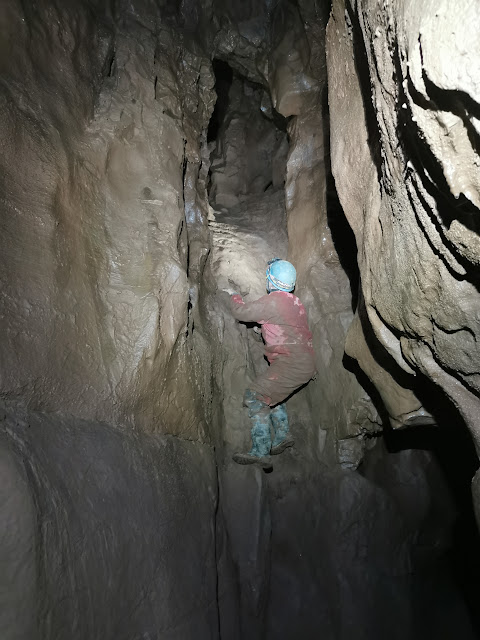
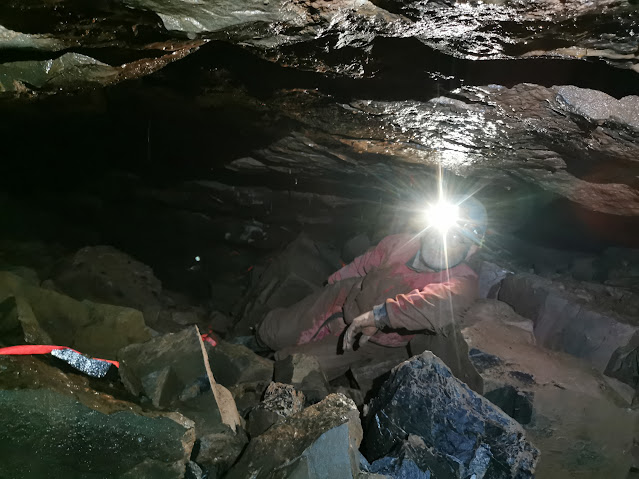
Investigating beaver sized holes

We found a collection of passages that fizzled out, or were only passable if you were the size of a beaver. The only way on appears to be down another hole in the floor, but we’d failed to bring any spare rope, so that will have to wait for another day.

Paul investigating a blind climb, using the head-jam method of levitation 


Another tempting no exit

The only consolation was that this area contains cave chocolate, unusual types of formation. Some loose rocks were clearly made from After Eight mints. Seeing as we weren’t entirely sure where we were, we shall hereby name this place After Eight Chamber.
  
Cave confectionery in after eight chamber

One of the side passages led mainly to formations made of chocolate covered cornflakes.

Cave cornflakes

As we were thwarted in our mission by an unexpected pitch, we decided to resume our hunt for hanging death. Somewhere, not on the survey, is a link from Big Chamber to the passageways taking you to the Columns via the SRT route. We reckoned hanging death was to be found around there, so we ditched our SRT kits and headed up to the top of Big Chamber for a crawl around. 

Dropping into Hanging Death

We reckoned hanging death was to be found around there, so we ditched our SRT kits and headed up to the top of Big Chamber for a crawl around.

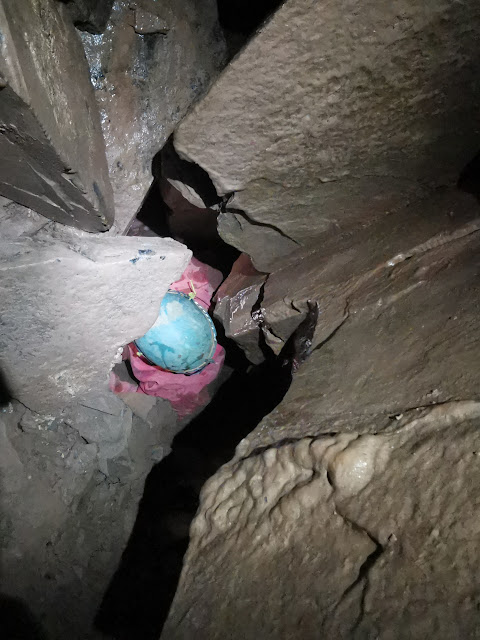
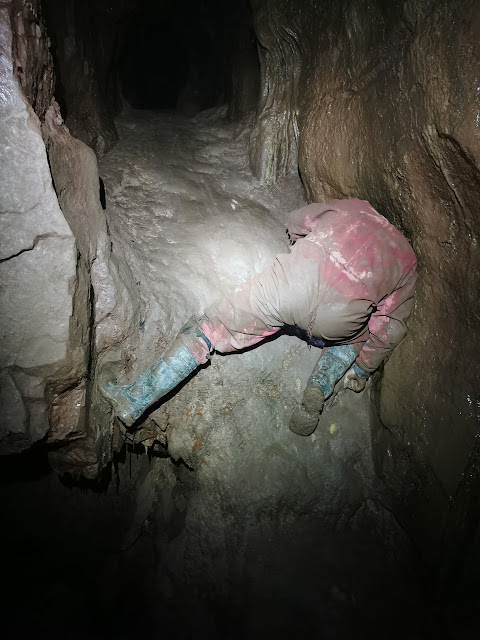
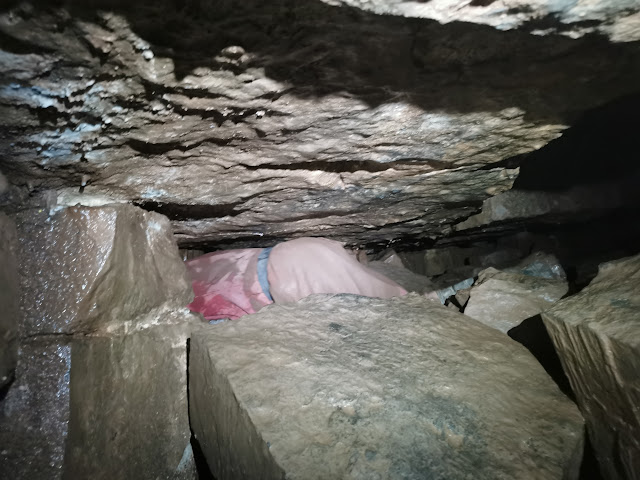
Sure enough, on looking in the most unlikely of places, we found the right barely-body size holes between boulders, and crawled and wriggled our way through a boulder choke.


Wriggling through the choke


Finally room to sit up

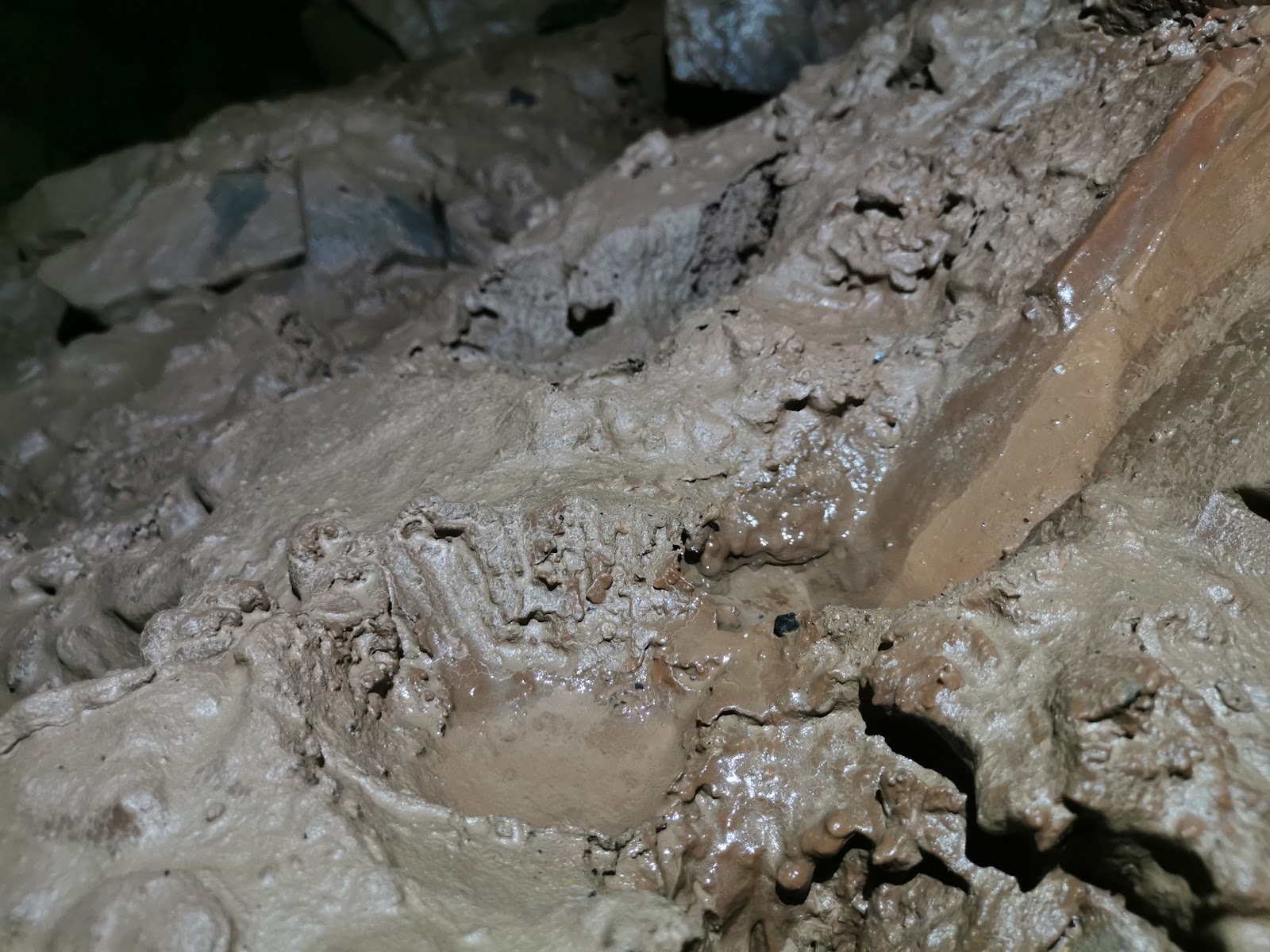
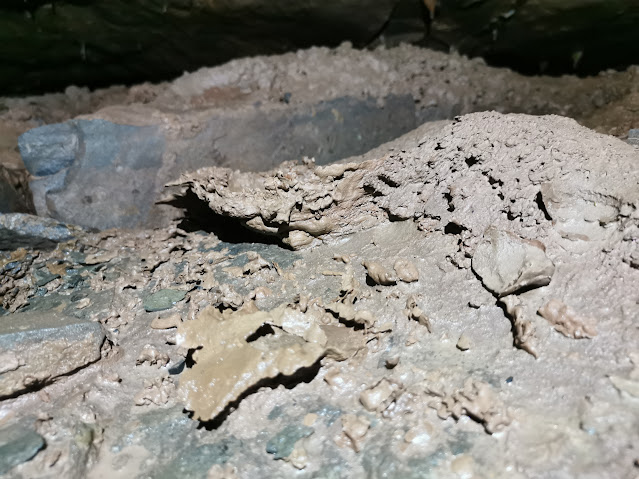
Paul sounded very pleased when he entered a chamber and saw tape. firstly, the end of crawling through miserable, second, tape normally signifies something pretty to see. In this case, i think the person doing the taping, I'm guessing Dave Dobson, has done a great job. Instead of  the normal stal, there is a lot of mud taped off. My phone did not do justice, but there is a strange beauty about undisturbed cave mud, as well as the scientific value. It was also good to see mud preserved in places where sensible people don't bother going.

Beautifully preserved mud

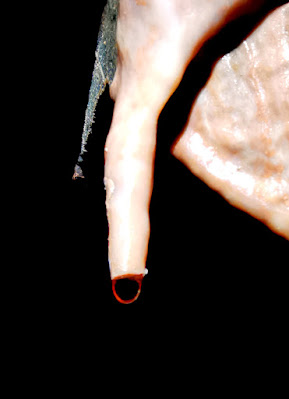
A fine mud drip indent

We turned round and completed the Beyond Big Chamber round trip (recommended for taking people that have upset you). On our way out, we mused over geological features and attempted to work out what we were seeing. Andy Freem’s training led to more questions than we have answers for, but it certainly gave us greater knowledge to ponder over.

Interesting colours to ponder
Exploring the lesser visited areas so close to the entrance was a great way to spend a few hours. However, I strongly recommend that you never try caving in borrowed Hunter wellies! They are much more suited to traversing the high street on a damp day.

Sunday, 5 November 2023

An introduction to the Geology of OFD

Author: Helen Nightingale

Course Date - 28th October 2023


Andy Freem, accompanied by Prof Peter Kokelaar, ran a 1 day course introducing us to the geology of OFD. It was a truly fascinating day exploring Top Entrance, teaching us about the local geology. Any factual errors in this blog are entirely mine.

Not quite geology but a fascinating example of fungus growing from a dead Herald moth (Scoliopteryx libatrix) near the entrance.

OFD is mainly contained within a bed of Dowlais limestone, which is about 100m deep, and is laid down on a tilt, hence the cave has significantly greater depth from top to bottom than 100m. Above the Dowlais limestone is a thin bed of honeycombed sandstone, 1-2m thick, then above that is Penderyn Oolitic limestone.

Andy explains the significance of Dowlais limestone on the surface above top entrance of OFD.

Before going underground, we talked about numerous landscape features important to the formation of the cave. You will have to imagine for now, that there is no Tawe river, no river valley, and there are mountains another couple of Kilometres higher surrounding us. Imagining what is no longer there is quite a skill.

Attendees of the geology course, standing where the entrance passage used to be.

As soon as we entered the cave, we saw interesting things. Pause a moment at the gravel pile just inside the entrance. As you let your eyes adjust to the darkness, consider the fact that all that gravel was carried into the cave by glacial flow via the chimney above. When the cave was active, if you could stand at the gravel pile, you would not be near the entrance, but mid-passage.

The gravel pile at the entrance we all walk past without a second thought!


The passage would have extended out into the now-invisible mountain range. Not much further in, we can see dissolution tubes high on the walls of the cave.

Dissolution tubes high on the walls.

The sandstone and oolitic limestone are not conducive to cave formation, and the Penderyn bed on the whole makes a strong ceiling for the cave and is readily visible as flat exposures in the ceilings. The strong rock which makes the distinctive flat ceiling is described as "competent", good at not collapsing. Very different to a few mines I've been in, with highly incompetent ceilings.

Gnome passage demonstrating the strong ceiling, where the Dowlais meets the Penderyn bed.

Andy discussing geology. Here, very unusually, the cave has formed upwards into the Penderyn. There is very visible evidence of the highly bituminous limestone here.

The large entrance passage would have formed, then filled with relatively static post-production flood waters. The water at the surface was more acidic, so more corrosive, at the surface of these lakes. Flutings can easily be seen on the dissolution grooves, showing vertical rippling at the lake surface.

Evidence of fluting.

Dissolution characteristics are also readily found in the cave ceilings. We saw the main roof tube running above us through our route through the cave, created from phreatic pipes followed by the erosion of the limestone beneath. Also, this unusual collection of anastomosing dissolution tubes. If you haven’t seen this feature before, go have a look for it.
Roof tubes, the anastomosing dissolution tubes forming the cross like pattern in the foreground of the ceiling.
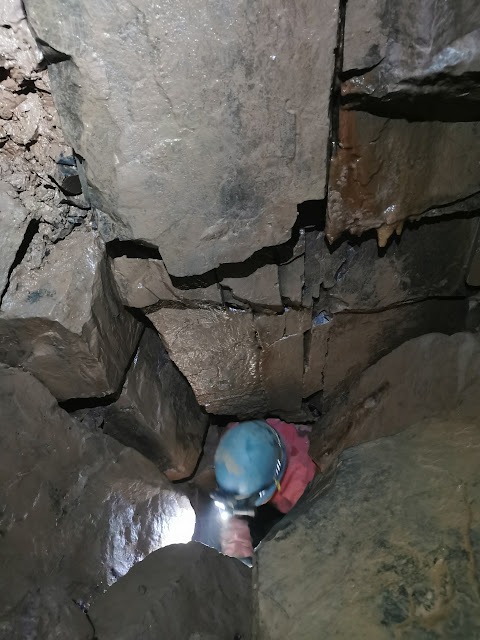
People often talk about the power of water in the formations of caves, but we don’t talk enough about the power of ice. We must consider that blue ice played a huge part in creating OFD as we now know it. Many of the blocks we are very familiar with were formed by ice effectively chiselling blocks away from the walls, moving a great mass of limestone against gravity.

Discussing the origin of blocks of stone.

An interesting feature to look for if you are loitering near any avens, is broken off stall. Domes of ice encased them, breaking off anything hanging in the way, then transporting it elsewhere.

Photo up Aven, where there used to be more stals.

Mud is also a very important feature in cave development that we rarely value enough. Whole passages would have been filled with mud or silt filled water, for thousands upon thousands of years. We saw mud banks made of numerous striations, showing each occasion where the silt or clay fell out of suspension and settled onto the floor.

Andy explaining the origins of this mud deposit.

In a location near Arete, there is a wonderful cut-away into the side of a mud bank, very clearly showing the many different layers, and spanning half a million years.

We had a look at some of the fossil beds, and talked through death beds and living beds - death beds being less dramatic than the terminology suggests, just fossils that were already dead when covered in sediment, rather than those in living beds - these had a rather more rapid ending. I do need more practice at telling the two apart. It's a bit like trying to tell if a Norwegian Blue parrot has croaked or not, if you don't know what you are talking about. I believe we saw mainly bivalves in the area we looked at with Andy, but coralline fossils can also be found in other areas of the cave


Schrödinger's coral, dead or alive?… definitely old!

This describes, very briefly, just a fraction of the interesting things we saw, and is greatly over simplified. I think all of us came away with a greater appreciation of what we can see if we explore the cave at a slow pace, and a greater understanding of the cave. Everybody went away enthused and wanting to know more. As we walked down the hill towards Penwyllt, clouds rolled in, covering the no-longer existing mountains of a past era. The geological complexity of Cribarth remained bathed in beautiful sunlight.

The walk back to the club, with renewed appreciation of the landscape.


It had become easier to imagine flood pulses ripping through the now remnant passages of Top, and spilling out from a long-gone entrance, sending torrents down the path we were walking. For me, it remains harder to imagine the desert plains of Penwyllt, complete with Pterodactyls in flight instead of crows, or indeed the more Alpine glacial scenery of Penwyllt – past. Perhaps don’t imagine a Dan-yr-Ogof show cave complex in an icy winter though!